On obligation and creative paralysis

Brains are frustrating things. One thing can gum up the works, and if you’re not familiar with brains — passingly, no degrees necessary — and more specifically with yours, it can be hard to figure out why. Even when you are familiar with your own brain, they’re like cats. When they’re hurting, they hide it.

I’ve had creative paralysis for some time. Some of it has been burnout (turns out I can’t do treadmill writing — working in the same series to a strict schedule). Some of it is stress (this month has already taken a year). Some of it is obligation (in this case, editing the next book in Broadsides).

All of the above had their impacts. Lately the largest culprit has been the last. Because my coauthor and I made the decision to have a break from Broadsides after this book, to reorient our needs and our capabilities — and a ‘break’, in this instance, just means we’re going to focus on other things for the next three months — there’s a part of my brain which has labelled all other writing as having to come after the next book is done and dusted.

That was at the end of October.

I’m barely into editing it. The final chapter isn’t even quite finished. (Sometimes going back and editing a whole novel helps gather enough momentum to finish those final pieces which seem so difficult to do from a standstill.) I don’t consider this writer’s block, because I don’t subscribe to writer’s block as a concept. There is always a reason for not writing. Always. And it is always within your control, one way or another.

In this case, it was the obligation which was gumming up the works. My coauthor calls it queuestacking (which I understand is from Homestuck, though I never engaged in it myself). It’s the act where the brain has filed actions in a certain order and one thing must be done before another. Of course, usually, the thing that has to be done first is an obligation, and the second thing something fun.

The fact that Broadsides has become something of an obligation is a bad sign, hence our decision to finish where we were at. But because I was denying myself writing fun, I was making myself panic and finding myself incapable of finishing the things that were in the home stretch. I had, somewhere along the way, traded my creative voice for my critical voice, without noticing — hence the creative paralysis.

Before yesterday, I hadn’t really written for weeks. Scraping out chapters of Broadsides, at best. It was miserable. To be proud of writing two days in a row feels like such a long fall from where I was: but here I am. I won’t wait until I’m Done With Obligations before I keep writing for pleasure.

I’m not quite out of the woods. I do have a responsibility toward my coauthor to get the bulk of this done before a specific time. I’m still aiming for another book release this year. I need to look for another job. And I’m unexpectedly having to contend with Emotions surrounding NaNo and/or not doing it. So, I’m still at risk of creative paralysis, which is the for my panic usually takes, and I’ve gotten into some bad habits about talking myself out of writing when I might have otherwise.

But at least I’ve IDed the sucker now. It’s going to be painful for a little while, but I can still take a breath and keep moving, step by step by step.

On opportunities for learning

(Or, why it would be a good idea to take advantage of WGM’s Teachable sale.)

Dean Wesley Smith, Kris Rusch and WGM are doing another half-price sale on writing-related courses, both craft and business. It’s their fourth this year and their fourth ever, and every time they say they hope it’ll be the last, because the sale is on offer primarily in response to the plague. So it’s worth not ignoring. Dean even has a loose recommended curriculum here, if you want to learn but aren’t sure where to start.

Dean and Kris have been professional writers 30 years now, going from traditional to indie, with additional editing backgrounds (a description which does neither of them justice, so go have a google if you’re interested in specs). That means they are possibly the best sources of learning for any writer who wants to make a living from their writing.

I cannot recommend them enough if you can afford them, even if you think you know what you’re doing (maybe especially if you know what you’re doing). I’ve taken Genre Structure (series of lectures with self-assignments) and Covers 101 (series of lectures with instructor feedback). I’d like to do Fiction Sales Copy, but I’m not in a position where I have the capacity for the emotional intensity required for a course beginning very soon.

I say emotional, because most of the learning here involves unlearning things I already thought I knew. That’s why I think these courses are the best possible value for your dollars, no matter the currency, compared to whatever university degree you’ve done in creative writing (which I did). Dean and Kris know not just what’s needed, but what isn’t, and what has to be unlearned. The standards they expect out of writers in terms of boldness, gumption and curiosity can feel unfair and scary to the writer who isn’t prepared to be humble or for an emotional wringer, but if you are, it’s well worth it.

If you can’t afford their courses even at a reduced price, both have loads of resources on their websites. They often write up business-related books as blog-posts first, and leave the blogs posted so you can find them for free. (I’m taking advantage of that for learning sales copy in lieu of doing a course, for now. Turns out this is one of those things writers think they don’t need when they really, really do.)

It’s the kind of week where I’m having trouble thinking of a pithy one-sentence blog-ender, so consider this the end. With my emphatic encouragement to keep learning.

On doing your own covers and rebranding

I think I’ve talked about this before, but among indie authors it’s a truism that covers are both sacred and a MacGuffin. Do it right, and they’ll ensure sales. But better not do it yourself, because you might screw up.

That might be a little unfair, but not far off the mark. The vast majority of writers I’ve seen, even professionals earning a solid income, recommend hiring someone to do your covers with a consistency I find rather irksome for two reasons.

One, I like having the most control I can exert over everything in my business until I understand it well enough to know whether or not it’s to my benefit to continue or outsource.

Two, I dislike being told not to do something on the basis of ‘you’ll probably just screw it up anyway’. I’m spiteful like that.

So every time I see writers pile on the ‘get a professional, don’t try it yourself’ train, I get a little more spiteful still.

I do my own covers. I made that choice because I couldn’t afford either the lead-time or the cost of having someone else do them, and because of that element of control. The spite came later, and came hard, because if I’m going to not do something, it’s going to be on my own terms, not just because it’s hard. Other reasons came later still, which retrospectively reassured me of the decision.

To be clear, it’s not that I haven’t screwed up my covers. I have! I didn’t know what I was doing! Screwing up is inevitable. But I tried, and I learned, and because I was willing to try I also made myself capable of learning. Luckily for me, WGM came out with a new course on making covers recently, which as far as I was concerned couldn’t have come at a better time — except for, maybe, if it had come earlier.

So I now know how to actually make the covers I’ve been making. And I’ll continue to learn how to do covers, better and more efficiently, as long as I do them myself.

They’re really not that difficult. Full-on, for something new, the way new skills always are — but eminently doable.

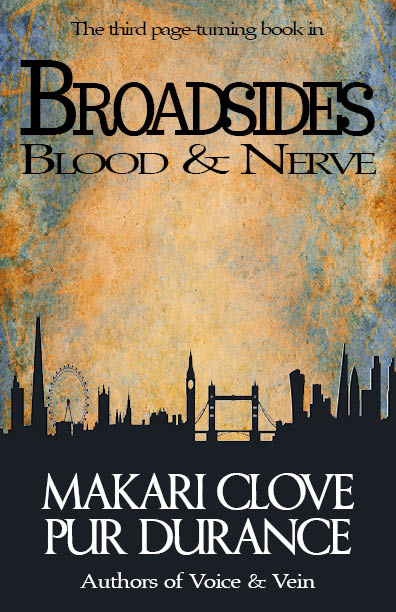
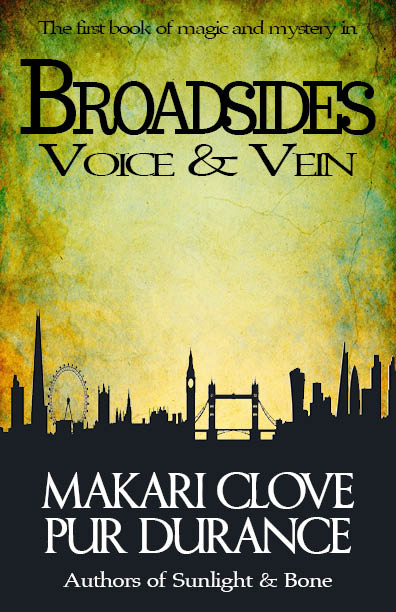
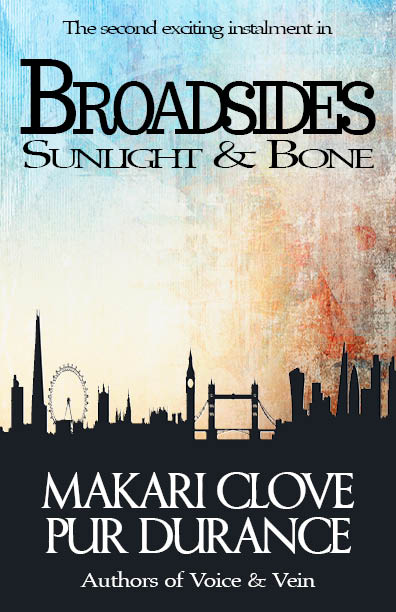
Which is why I’m very pleased to now show off the rebranded covers for Broadsides. The fourth book, which will be coming shortly (exact weekend pending, but before the end of the year), will be the first book branded in this style right from the very beginning, and honestly I couldn’t feel better about it.

Having a series brand means that I have a formula to follow. It means that I actually don’t need to do as much work, nor spend as much time or money, trying to fluff about the way I was before. It’s a relief, and I’m looking forward to having that burden off my plate.

So without further ago, here are the new covers for books 1-3 of Broadsides. By the time the fourth book arrives, books 1-3 will have been updated, both digital and softcopy, in all their branded glory.

On emasculating ourselves with negative humour

Stand up (or sit down) if you’ve ever made a joke about needing a friend to stand over you with a whip and chair to make you write.

Or about being easily distracted. Even with other stories instead of the one  you’re ‘meant’ to be writing.

Or about procrastination.

Or about being unable to finish.

Or about your work being trash.

Or about your tastes being trash.

Or about being surprised that you’re getting attention for a story in public view. (Or being actually surprised, and showing it.)

Or or or or or or.

Yep. Everyone has. I have too. I don’t anymore.

Writers undercut themselves. Writers make it easy to bring themselves down because by the time someone picks up the axe, half the work is already done — by what we say, and how we joke, and the way we make ourselves feel. Jokes aren’t jokes if they’re the same, every time, and almost without exception at the writer’s own expense. Self-deprecating isn’t self-deprecating if you believe it. Then it’s just self-derogatory. And that isn’t funny.

The words we use are important. The narratives we grow, as a community, determine the attitude of those coming into it.

I don’t spend a lot of time in writing communities. In general, and also lately. I’ve been more annoyed than not the way writers ‘joke’ about how terrible they are, with their discipline and their management and their ability. It strikes me as more performative than real. People with imposter syndrome usually hide that they’re feeling it, for fear someone will find out they’re undeserving; writers put it on display, as if somehow the fact they’re ‘terrible’ at their passion proves they’re really writers. I’ve even seen successful, popular authors do it, like that one smart kid in high school terrified about the A- they got instead of an A.

If you don’t want to be terrible, then don’t act as though you are. If you’re not terrible, then acting as though you are (whether you believe it or not) looks, from the outside, insincere as hell. It’s as though writers expect someone to make a pothole in front of them, so they may as well do it.

No more. No jokes about inability. No thinly-veiled self-recriminations. Stand tall. Don’t flinch. Walk long. Fall. Get on your feet. Don’t stop.

Hold your head high. Don’t bend when those around you act as though they’re less than they are. Stand tall and take pride. Be fierce. Protect your right to have faith in yourself. You don’t need to suffer for your passion. Acting like you’re lesser for the laughs, because everyone else says those things, eventually creates a truth in you that you aren’t capable.

There’s enough people willing to cut your legs out from under you without you helping them. Because if you do, sooner or later you’ll realise that the person most responsible for the potholes is you.

On putting in the effort vs doing the work

The conventional advice, when pursuing writing as a career, is not to give up your day job. Generally speaking, good advice! One still needs to be able to support themselves.

Which I ignored, for several reasons. Firstly, the place where I was working had become untenable to me and I had to quit for my own health regardless. Secondly, I had the means, thanks to a very understanding and generous father. Thirdly, I’ve always learned best by jumping in the deep end.

I always knew I’d go back to working for someone else. There was a part of me that wanted to believe I wouldn’t have to, but more and more lately I’ve been coming to understand that the conventional advice isn’t just for pragmatic reasons.

It’s about play. The pressure to generate an income has made my writing ten times harder. At first, having the time off was wonderful. Then the plague hit. And slowly, progressively, I’ve been getting more and more tired and less able to write like I did. For one thing, I need a break. (The whole world needs a break.) For another —

For another, there is a vast difference between putting in the effort and doing the work.

For me right now, writing is work. That’s not how it should be. The publishing side? Yes. That’s work. It’s business. It’s crucial to developing the career. That means there’s some degree of scheduling required. Some degree of discipline. In order to publish, I need something to publish. 

But the writing itself shouldn’t be about work. It should be about fun. Even fun requires effort. Especially for my generation, who are perennially burnt out, and find it more difficult than previous generations to put down even long enough to rest, or muster the emotional investment in something we enjoy. Anything which which passion wrought requires effort, and tenacity.

Effort is not work. Effort is, often, its own reward, along with its friend, satisfaction.

I think people my age and younger have been duped into thinking that it is work. That effort is obligation. That anything worth investing in must, by definition, be work. 

I want to earn my living writing because I know I can write, and because having that as a career means that I can choose my own schedule, that I can reject the conventional capitalist hours. That I can be lazy, consciously, deliberately, and enjoy it — provided I’ve done the work.

That’s going to take both work and effort.

Right now, I’ve put in the effort. I need to put in a little more before I can put down for the upcoming holiday. And I’ve done the work, and it’s leeched all over what ought to be fun. It needed to be done, because I needed to learn it — and now I need to untangle it from what it shouldn’t be.

I used to think I’d never go back. Now I’m almost looking forward to working for someone else again, if only to give my writing room to breathe. It’s a bad time to have to go looking, but it’s better than the alternative.

The last year has been my ‘gap year’, which I took to learn — on the job, as it were. Now it’s time to separate my work from my effort.

There will, of course, come a point when I’m earning enough from my backlist that what I write and when I write it doesn’t matter quite as much, as long as I’m still writing. That day isn’t now. But I’m looking forward to it, and preparing for it, by removing the pressure, so that I can continue to give the effort to writing which it deserves.

Word spotlight: Politics

There’s a question going around in Twitter’s writing community asking writers how they feel about blending politics with professional media. I have a few feelings about that, and couldn’t figure out where to start on a tweet thread, so I decided to do a word spotlight instead. This is definitely going to be an ‘etymology vs modern use’ post, everyone, and ‘modern use’ comes out the loser.

Etymologically speaking, ‘politics’ is rooted in Greek ‘polis’, which literally refers to a city, state, community or citizens. Fast track that down the etymological timeline and the dictionary defines ‘politics’ in the 1500s as ‘the science of government’, which is the most recent entry before modern definition (left blank).

Honestly, I really like that definition, mostly because it has the word ‘science’ in it. It turns politics from being a cultural voodoo into a rational school of thought relating specifically to governments. Obviously, if that’s the case, then the science of it has been sorely betrayed and abused, especially the last few years.

How does this relate to a question on Twitter?

Because of the use of the word. The original poster was asking earnestly and I’m guessing had been confronted or accused by someone reprimanding them for getting ‘political’. The thing is that the way we use ‘politics’ these days has nothing to do with government and everything to do with daily lives. The word’s become divorced of anything governmental and has been weaponised to distance, other, and shame people with certain lived experiences (and many of them).

I don’t think it’s a far stretch to say that saying someone is ‘blending politics with their [insert profession, hobby, art etc]’ is the same as asking someone of another ethnicity ‘where are you from?’ Whether intended or not, the very question implies that someone’s lived experiences are performative for some unknown reason, out of principle, or otherwise theoretical. It pretends that those experiences are, somehow, a hat someone is wearing just because. It denies a person those experiences, and turns the experiences into a tool (or a weapon) instead of just a life.

Calling someone else’s life ‘politics’ devalues it. It says that since those aren’t your lived experiences, they don’t count. 

If we didn’t use the word ‘politics’ this way, maybe people wouldn’t be surprised when a Black American kneels during the anthem to honour murdered Black Americans —

When a lesbian writer talks openly about writing about a lesbian protagonist —

When women in need of abortions object to losing their healthcare —

When trans* people exhibit their fear they’ll be murdered just for going to the bathroom.

These aren’t politics. These are people’s lives.

Stop using politics to talk about someone’s lived experiences. Start using it only when talking about governmental processes, policy, and science. If people can start realising that ‘where are you from?’ is offensive, maybe people can start realising that so is ‘why are you being political’ — when all someone did was live their life openly. 

After all, words matter.

On weariness and knowing when to put down

I am tired. Today, I’m tired. Nothing seems good, and everything is hard, after several long weeks of everything seeming hard.

I read a post by a writer this morning which observed that their difficulties writing might stem from the inability to be vulnerable … that releasing the numbness to feel emotion while writing, and then risk something happening while they were ‘gone’, is something they may not be prepared for. I don’t know if that’s the case for me, I’d have to sit in it more; it feels more like emotional congestion than numbness.

This morning I also read Kris’s new blog. Aside from appreciation for ‘rage donating’, which I wish I had money to indulge in, that post reminded me that, a few days ago, I was contemplating the idea of putting down everything written except Broadsides. That’s about 30-40 thousand words every 8-10 weeks, on a single project. Usually I write whatever comes to mind, often multiple stories at once, switching them out as needed so I can write 6 days a week, because usually that word count across that span of time just isn’t enough.

Now, though …

Still seems like pittance. Pathetic, provides my brain weasels.

But stronger than that, when I think about only paying mind to one project, one story at a time, not having to drag myself to my chair and try to be creative — I feel relief.

I had grand hopes at the start of this year. I suppose after a fashion I still do. My initial plans for 1 million words is a distant mirage. 8 new releases too. 4 newly released in a year won’t be bad, though, and it was my minimum goal. The grandness remaining comes in the fact that I’m still going. Slowly, barely it seems like — 40 thousand words in 10 weeks! — but going. And learning.

This year was always going to be about the learning.

Sometimes that means learning what to scale back, and when to put down.

So I’m tired. For October, at least, the only written project on my plate will be Broadsides. I’ll deal with November’s writing when November comes.

On ‘putting it off’ and the value of timing

Last week I blogged about the hidden negatives of the ‘do it now’ narrative. After I wrote it, I continued contemplating the subject and realised — well, it’s not totally a one-sided concept. Like I said in the other post, the reason ‘do it now’ is such a common thing is precisely because the point is to ‘start it now’, instead of ‘putting something off’.

The sooner you start something, the sooner it gets done. This is a true fact! Especially when something has a lot of steps involved in it, the sooner you start getting those steps done, the sooner you’ll get to the end of them. There’s value in promptness, because if you never begin, you’ll never end. You’ll never progress, either.

Except: those three little words, ‘putting it off’. The corollary to ‘doing it now’ is that everything that isn’t done right away is ‘put off’. But is it?

Productivity language is important. It’s how we shape our perspectives on scheduling, time spent, the value of our hours, and our ability to forgive ourselves for failing. Offhand, and bearing in mind that I haven’t extensively researched this, I can’t think of any language which supports the idea of not doing something immediately. ‘Put off’ sounds inherently negative. It’s a denial, an evasion. Scheduling might count — but even scheduling often comes with a caveat of ‘put it in your diary now, right now’. Scheduling is like budgeting: for a tool that’s supposed to make things easier, it feels more like a noose. It’s something that highlights how you fail, instead of how to help you succeed.

This is one of my favourite blog pieces about that — not because it’s about scheduling per se, but because it focuses on the life you’re living, not the one you think you are or want to live. YNAB also goes into this principle, but with dollars instead of time (no specific links, unfortunately, their blog archive is Big and nearly all of it is worth reading). This kind of attitude awareness helps with the scheduling — or not being afraid of scheduling. I always thought diaries weren’t for me because I simply couldn’t use them long-term. I didn’t find them useful; I couldn’t muster the continuous desire to list things in them. These days I use a bullet journal, which, due to the fact I can make it look whatever I like and in formats that serve me instead of me serving the diary, I’ve found I can, in fact, schedule.

I’m lucky. I found my way to what works for me. But in productivity language, scheduling means something specific, and to which we have specific reactions. Just like budgeting. Because, for most people, the standardised assumptions just don’t work. And those standard assumptions include the idea that not doing something immediately is ‘putting it off’. Hello, vague sensations of guilt, shame, and inability.

My point here, I suppose, is that the language we use needs to change, and the mindsts need to change with it.

Doing it now isn’t always possible. Starting now is often a benefit: but how someone starts is unique to them. Doing something later is often valid and needed; and that means it isn’t always putting something off.

And, above all else, continuing from whence we begin links the two. It’s the most important part, because it turns the ‘now/later’ dynamic from binary into scaling. Realise that everything you do is a span of time, not a single moment. That means you can’t do it now, because some of ‘it’ must be done later. It builds, invisibly, until it’s no longer invisible.

What is ‘it’? You name it. Art. Skills. Thoughts. Desires. Plans. Money. Nothing is ever an isolated point in time. This is why splitting activities into chunks comes so highly recommended: it turns something big into smaller, easier-to-digest pieces. But our brains also don’t want to work that way. Often, all brains see is the whole, not the sum, and how many of them there are. Pitting ‘now’ against ‘later’, instead of using them complementarily, exacerbates that tendency.

I’m doing covers training with WMG and Dean Wesley Smith. I have been for the last three weeks, with three weeks left. They already have an October module out for enrolment, and I seriously considered doing that one instead of the September one, because September at the time ‘felt too close’. I wanted more time to think, to plan. I didn’t, and I’m glad, because that would have been putting it off. When the reasons amount to ‘I’m scared to invest’, when you know it’s something in which investment is going to happen, ‘doing later’ is ‘putting off’.

But last blog I mentioned there were a number of ideas I had which clamoured to be heard, and I felt anxious about getting them done. Guess what? I didn’t do them right away. And they still got done. Because I knew the value of what I was already doing in those moments, and I trusted my future self to come back to those activities at a time which was more appropriate for them.

Timing matters. The timing for one thing will be ‘now’, and the timing for another will be ‘later’. The trick is telling the difference, and being gracious enough to put the ‘later’ things down, or finding management techniques which work for you to enable the putting-down. Act now, when you can, to help your future self: but when your present is already full, trust that your future self can pick up the slack.

Life is a series, not a standalone. Don’t be afraid to leave your life narratives for another time, if the ones you’re already living are enough.


I’m a new indie writer-publisher and blogger, which means I need all the support I can get! If you want to help me out, you can buy me a coffee at my Kofi page.

On ‘doing it now’ and the illusion of speed

Recently I had a realisation. I’ve spoken in my blog before about the essence of speed and the difficulty slowing down and being calm or gracious about it. This realisation relates to that.

It’s no secret that today’s society is a fast one. With immediate access, FOMO, ‘get in first or lose your opportunity’ sales marketing — honestly, everything being rushed and hectic is a truism. This isn’t the realisation.

I like reading productivity books. I hesitate to call them self-help books because, well, I don’t think of myself as a person who needs the aid of a book to figure out who I am, which probably says something about what I associate with the term ‘self-help’. Productivity and decluttering are my fascinations — using time efficiently and having less stuff. So when I talk about the books I read, those are the books I mean. This also isn’t the realisation.

Raise your hand if you’ve ever read a book in this broad genre which said something to the effect of ‘go ahead and do this now. I’ll wait.’

I’ll lay money that most books have some variation on the theme. And I get why it’s there: when something feels hard to begin, having someone, anyone, hold you accountable can ease some of the friction. I use the same technique myself sometimes, and so do my friends: “Tell me to do [x]” is a common if irregular refrain in our chat group.

This kind of command has become ubiquitous in these kinds of books. Trying to get your stuff organised? Almost certainly you’ll get the order. Reading a book about how to begin that big project you’ve been putting off? Chunk it, the books will tell you, and then get started on the smallest step right now. I’m pretty sure even my favourite book about habits, James Clear’s Atomic Habits, does the same thing — though it might do it less than some due to its premise.

The thing is that this kind of directive often ignores the root cause behind why people procrastinate. People aren’t lazy by nature. If they find something hard, it’s because there’s emotional baggage attached, or they aren’t neurotypical, or they’re simply exhausted from x other thing, or they have so many things already on their minds that paralysis has set in.

That’s a problem because, let’s be real, no one remembers the context. No one remembers that big projects are completed by many smaller steps. All they remember is ‘do it now, don’t put it off later’.

The implication therein being: if you put it off til later, you’ll never get it done.

If you put it off til later, you’ve already failed.

The only way to succeed at a task is to do it now

That was the realisation: that the reason I get anxious about doing things fast, the reason I have the urge to do things now, is because I’ve internalised the idea that they cannot be done later. That later is, in itself, a failure. Marry that with the aforementioned societal speed and, well …

You can see how that’s a match made in hell.

Like I said, the directive is well-meaning. But it’s not enough to simply have someone order you to do one thing or another. It works incidentally, not as a solution — as soon as the book’s finished and shelved, the clutter begins, time begins to pass, the projects don’t get done. Things rarely end just because they’re finished. Making shit happen is a long-term process that cannot be solved by ‘do it now’. By continually focusing on ‘do a thing now’, these kinds of books inadvertently ingrain the idea that now is what matters most, not over lengths of time. Immediacy is still the value here.

Immediacy is the value in traditional publishing, too. Immediacy is why people think there’s no in-between for impoverished author or wealthy bestseller. Immediacy is why careers end if books don’t take off on release. Kris and Dean go into this substantially more, so I’ll put links to their blogs here and leave it at that.

This is what caused the realisation for me, however. I often get ideas about how to proceed on any given thing on my walk. Earlier this week I had several, all at once, and clamouring to be done as soon as I get home. The thing is that I have a routine after my walk. It’s a routine that starts my day and gets me settled, and gets the important stuff — writing — done first.

A starting routine shouldn’t make someone feel anxious or as if it’s getting in the way. A starting routine is the platform from which the rest of the day springs.

I shouldn’t have to feel like I’ve failed just for something not being done right now.

Publishing is a long-term business. Especially indie publishing. I’m now nearing the end of my first year, so I’m relatively new to many respects, mostly business-related. Learning doesn’t happen immediately: learning happens over time. The part of me that’s impatient to be at my goals already is tied with the sense that if I don’t go fast enough, if I don’t do everything now, I’m failing by proxy.

A career doesn’t happen upon orientation. A career is a span of time.

How many people see the well-meaning directive ‘do x thing now, don’t put it off’, and internalise that now is the only thing that matters? That putting something off is failure? That, regardless of their capability in the moment, they’re failing themselves not to overcome?

It’s a big mess that feeds into itself, and regardless of its intention, the focus on ‘don’t wait, act now’ dispowers the people who internalise the directive while being incapable of ‘acting now’.

I talk about power and empowerment a lot on this blog. That’s because I believe it’s one of the most important things a person can do for themselves. When you speak, think or act in a way which inadvertently removes power, it’s something worth examining. No one should ever be obliged to undermine their own agency. No one should ever have to stand for it being removed from them. Not even by themselves.

Relying on an external directive to do x thing can work, if it’s a rare incidental push from a friend. But the best way to make things happen, no matter the technique, is to find the causes behind why a person might not be doing it, and address them, in ways that work for them, not just because someone else said so. That brings agency back to the person. And that’s not always easy, or even possible, at any given time, because it can take a lot of energy — emotional, physical and mental — to examine oneself that deeply if it isn’t a realisation someone’s already made.

For me, right now, I struggle a lot with ‘now’ and ‘later’. I want to be successful now; I want to be earning a full income now. That’s not going to happen. Publishing is book by book, building reputation and readers and backlist. By necessity, it happens over time. Or at least, it does if you want the foundation to be solid and lasting.

But I’m slowly and surely managing to unwind my sense of immediacy with my sense of obligation and my sense of failure. If anything, it’s making me more determined to succeed: because I’m slowly internalising that success isn’t immediate. It’s one step after another, unstopping — even if, now and then, your direction has to change.
On critical vs creative editing

Not a new topic for me, this, but one I have a few feelings on and one I thought would make a good opener to my cross-posting to tumblr. (Which I am now doing. For the record. Hi, tumblr followers.)

From my very scientific observations of writers in general, most of them seem to view editing with certain measures of distaste if not downright loathing. It’s the little casual narratives — the ‘ugh I have to edit x thing’ complaint followed by sympathy from everyone else, and suchlike. Editing, from what I’ve seen, gets a really short thrift. It’s a necessary evil, but no one ever wants to do it.

Well, I do. I love editing. It’s one of my favourite parts of writing. Writing is hard. I need to birth that shit from nothing. Editing means I get to read my work again and make it better, and since it already exists, it’s that much easier.

This is, I suspect, because I don’t edit the same way most writers have learned to do. So, this post is about distinguishing the difference between two types of editing, and why only one is worth anything.

Note: it’s not the one that’s taught in university. Writing degrees are, almost without exception, about analysis. It’s a search to find what works, and ‘fix’ it. The problem is that that kind of analysis does it by finding the imperfections and labelling them as wrong. As something to be fixed.

This might sound like an obvious ‘duh’, but when was the last time someone pointing out all your flaws ever made you feel good about yourself? Psychologically speaking we know that the best way to change someone’s mind isn’t to attack them. Obviously, if a writer is so psychologically bound to their work that any amount of criticism is a personal affront, that’s a problem. But why are writers expected to sit back and thank people while having all the mistakes of their best efforts exposed?

This is what writers think editing is. This is, in fact, what critical editing is. The focus of critical editing is to tear down, to expose flaws, as if just the having of imperfections is somehow sinful. And this is the kind of editing writers everywhere think is normal.

Right.

My coauthor, when we talked about this, had an analogy. She likened writing to sculpting, and editing to the polishing. When a sculpture makes their art, it starts out raw and slowly gets refined into the image the artist wants. Over time, rough edges get polished away. They’re not flaws: they’re just hiding the actual representation the artist is trying to find. It’s the same concept as sketch (or other) artists using white space to find the shape they’re really after.

Creative editing is like that. It’s not about the flaws; it’s about finding the best way to tell the story you want to tell. If there’s a part that’s too bulgy, smooth it out. If there’s a place that’s too rough, polish it a little. These aren’t ‘fixes’: they’re cleaning up what’s already there to make your work more of what you imagined, rather than less wrong.

Note that I’m not talking about drafting, here. I write one complete draft of my works. Often I will edit as I go, but when I finish my stories, I do a full edit that one draft, once. If it’s a co-written story, my coauthor will also edit: once. Then I clean up the remaining comments, without editing, and prep it for print.

Does this mean there’s flaws? Oh, hell yeah. No writer has ever written a perfect story. Ever. If it’s not going to happen, why expend unnecessary effort trying to get there? I do the best I can at the time and send it on.

Sometimes, if I’ve started from a place that doesn’t work for the story, I might have to jettison and start over, but it’s always in search of what will tell the story best. It’s not about wrong or right; it’s about need and purpose. Those words that I wrote aren’t a draft: they’re scrap. They told me something about what my story needed, and they weren’t it.

Drafts (multiple!) aren’t creative editing. Drafts are critical editing. They’re a search for perfection and the difficulty accepting something just as it is: a complete object, however imperfect, which nevertheless exists.

Critical editing tears down, exposes flaws for the sake of exposing them. Creative editing sees them as inspiration, as a path to the image you’re actually after.

Critical editing forces you to actively look for things you’ve done wrong. Creative editing lets you revel in what you’ve wrought, regardless of imperfection.

Maybe critical editing does help you make your work better, but if there’s a choice between feeling terrible or feeling inspired while you do, who would ever choose the former? Not I.